.webp) 18+
18+
18+
18+
97% RTP, high volatility, and a provably fair RNG — here is exactly how to approach every round without kidding yourself about the math.
Free demo — no real money. Mirrors the real game's behaviour. May be unavailable in some regions.

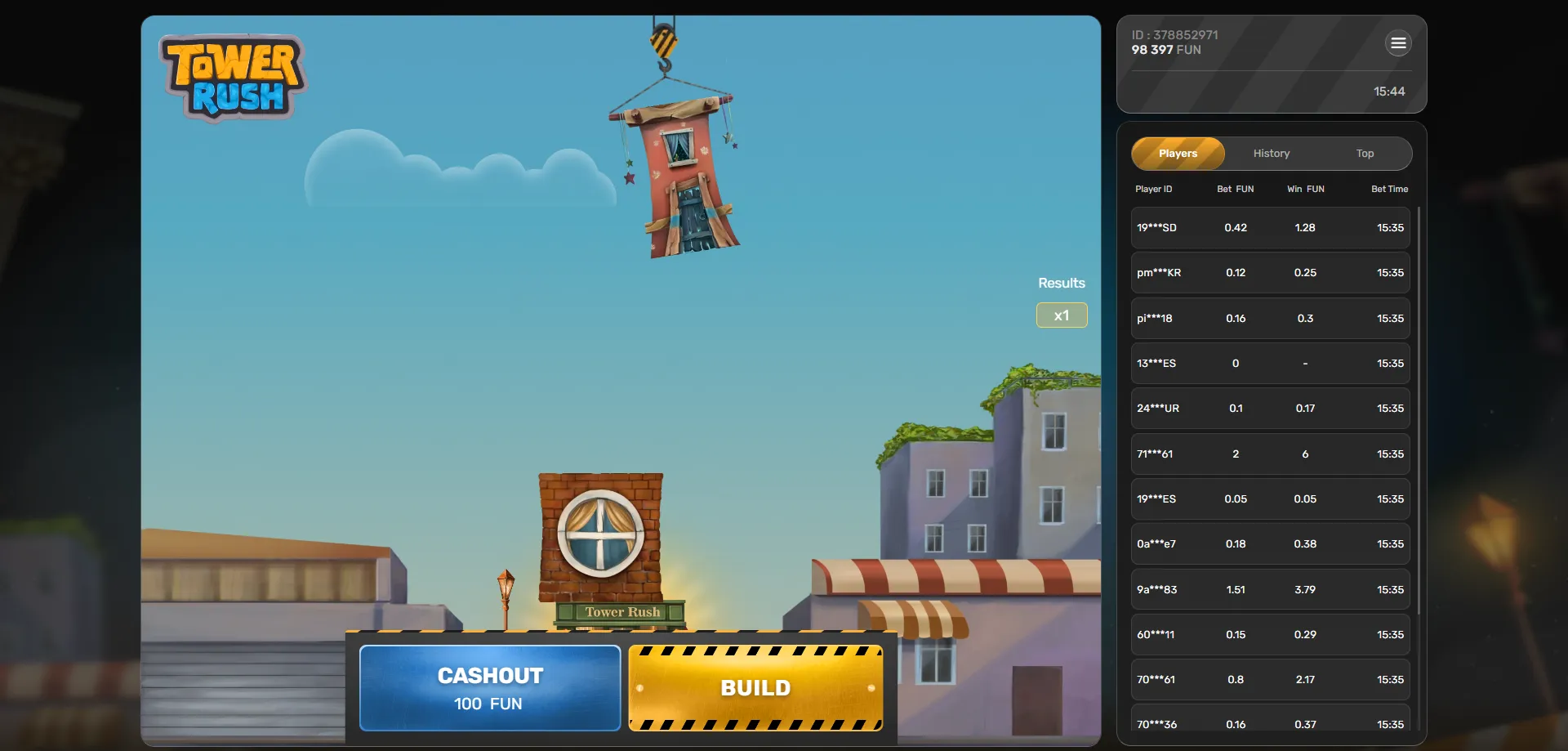
97% RTP and high volatility — that combination tells you something important before you place a single rupee: Tower Rush will return a strong share of bets over the very long run, but in any single session the swings can be brutal. The tower can collapse at 1.01× as easily as it can climb past 20×. No strategy in the world changes that underlying randomness, and anyone who tells you otherwise is selling something. What a solid approach can do is slow the rate at which variance drains your bankroll and keep your decision-making rational when the multiplier is climbing and your palms are sweating.
Before you read any further, take note of these non-negotiable ground rules our team applies every time:
These are not glamorous insights. They are boring, proven principles. The Tower Rush game tricks that actually work are almost always about discipline, not discovery of some secret pattern.
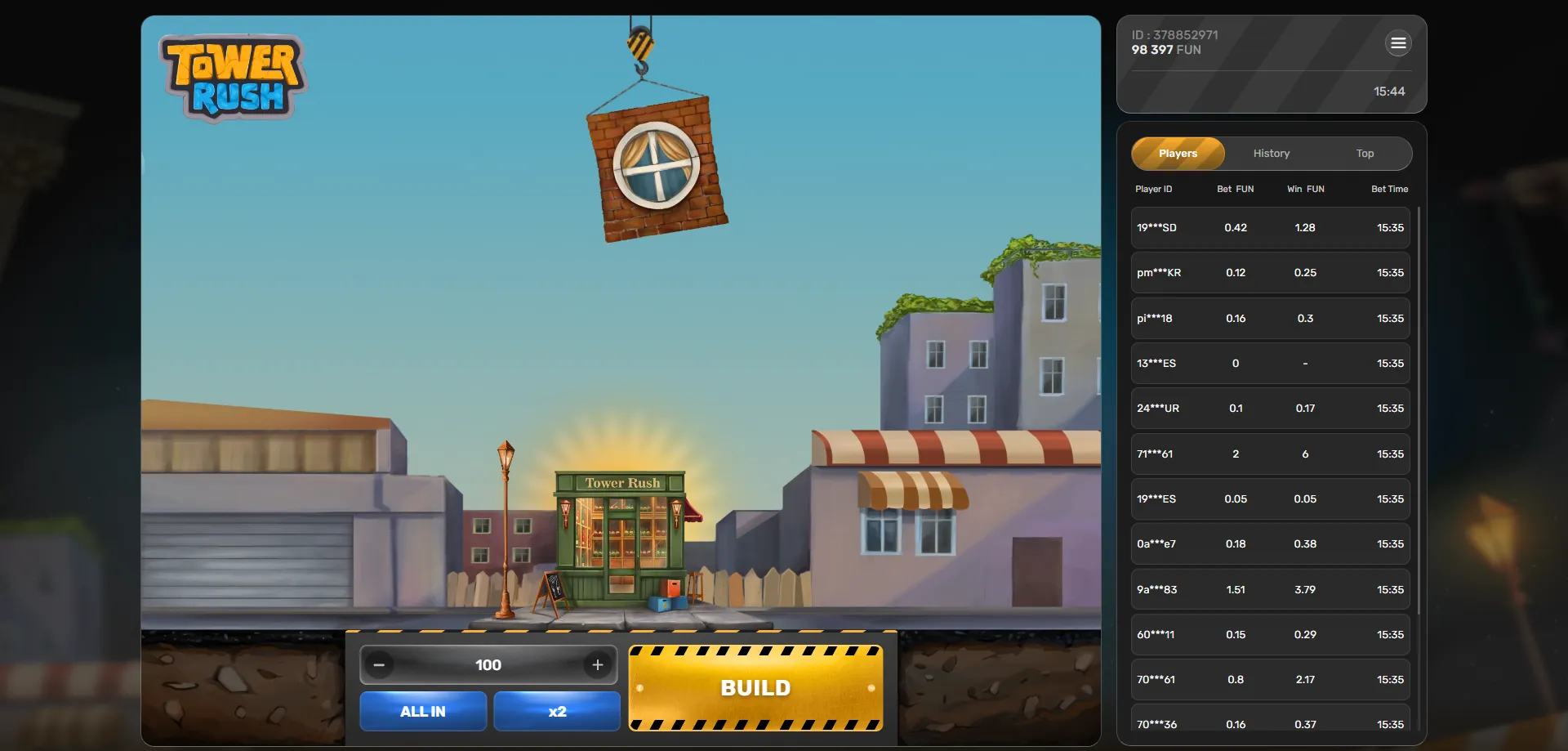
Below are four distinct approaches to stake sizing and risk tolerance. None of them guarantee profit — the RNG does not care which method you use — but each one suits a different player profile and bankroll size. Read all four before deciding which fits your situation.
The simplest and arguably most sustainable approach: pick one stake amount and one target cash-out multiplier, then repeat that combination every round without deviation. For example, ₹20 per round with an auto cash-out set at 1.80×. You do not double up after a loss, you do not chase higher multipliers after a win streak. The entire point is to remove impulse from the equation.
This flat-betting method works best for players who want to extend their session and enjoy the gameplay without catastrophic swings. The maths are transparent: you need the tower to survive past 1.80× on enough rounds to generate a net positive. At 97% RTP that is theoretically achievable, but variance means you will still see losing runs. Patience is the only edge this system gives you.
A variation of flat betting where the stake is deliberately kept at the table minimum — typically ₹10–₹20 — with the cash-out target set conservatively between 1.5× and 2×. The goal is frequency of small wins rather than size of individual payouts. You accept that each win is modest in absolute terms, but you stay in the game long enough for the 97% RTP to have statistical relevance.
This is a sensible entry point for anyone new to crash games. The low stake means a bad run of early crashes does not end your session in five minutes, and the conservative multiplier target means you cash out before the tower collapses more often than not. The trade-off is obvious: you will not generate large returns from small wins on tiny stakes.
This is less a "strategy" and more a rule of thumb that experienced crash players repeat constantly: resist the temptation to hold past your pre-set target because the multiplier is still climbing. The tower climbing to 5× does not mean it is more likely to reach 10×. Each fraction of a second is an independent probability event. The Galaxsys RNG has no memory of the previous round or your current position.
Set your auto cash-out before the round starts. When it triggers, take the win. If you find yourself overriding your own auto cash-out repeatedly, lower the target to one you can commit to psychologically, not just mathematically.
On the opposite end of the spectrum, some players deliberately target multipliers above 5× or even 10×. This is a valid style of play — but you need to go in with clear expectations. At high volatility, the tower will crash below your target the majority of the time. The model only works if the occasional large win more than compensates for the string of total losses. Keep stakes proportionally small (1% of bankroll per round), accept that most rounds will result in a full stake loss, and do not use this approach unless you are genuinely comfortable with long losing streaks between payouts.
The four staking systems below are borrowed from traditional casino and sports-betting literature. They are staking progressions, not magic formulas. They adjust how much you bet in response to wins and losses, but they cannot alter the game's RNG or push the RTP above 97%. Apply them with eyes open.
The most widely discussed progression: double your stake after every losing round, return to your base stake after any win. The logic is that a win at any point recovers all previous losses plus one unit of profit. In theory, the system always produces a small net gain given infinite time and unlimited funds. In practice, those two conditions never exist.
Applied to Tower Rush with a 1.80× auto cash-out target, a Martingale sequence looks like this: ₹10 loss → ₹20 loss → ₹40 loss → ₹80 win (net +₹10). That fourth consecutive loss before any win is common at high volatility. Five or six consecutive crashes before your cash-out multiplier is reached will require stakes of ₹160–₹320 to recover a ₹10 base unit. Most session budgets cannot survive that doubling sequence. Use Martingale only with very small base stakes and a pre-defined "stop" after a set number of doublings.
The Fibonacci sequence (1, 1, 2, 3, 5, 8, 13, 21…) dictates stake sizes after losses. Move one step forward in the sequence after a loss, two steps back after a win. The progression is slower than Martingale, which means it takes more wins to recover a losing run but is also slower to reach dangerous stake levels.
For Tower Rush players, Fibonacci suits a moderate-risk cash-out target around 2×–3×. The slower stake escalation gives you more breathing room than Martingale when variance runs against you, but recovery still depends on winning rounds arriving before your budget cap is reached.
A flat linear progression: increase your stake by one unit after a loss, decrease it by one unit after a win. If your base unit is ₹10, you go from ₹10 to ₹20 to ₹30 on a three-round losing streak, then back down on subsequent wins. D'Alembert is one of the most conservative progressions available, making it well suited to Tower Rush given its high volatility.
The maths only "work" in D'Alembert's theoretical framework if wins and losses alternate symmetrically — which they rarely do in real sessions. Still, the gentle escalation means you are unlikely to hit catastrophic stake levels during a normal session, making it a sensible choice for players who want some structure without the risks of exponential doubling.
The most complex of the four: write down a sequence of numbers (e.g. 1-2-3-4). Your stake for each round equals the sum of the first and last numbers in the sequence (1+4=5 units). After a win, cross off those two numbers. After a loss, add the losing stake to the end of the sequence. The sequence is complete — and the session profit target met — when all numbers are crossed off.
Labouchere gives you a defined profit target and forces you to think in sequences rather than individual rounds. The downside in Tower Rush is that a prolonged losing streak extends the sequence rapidly, pushing required stakes higher. Choose a modest starting sequence and cap the number of rounds you are willing to play before resetting.
Tower Rush uses a provably fair system developed by Galaxsys. Each round's crash point — the multiplier at which the tower collapses — is determined by a cryptographic seed before the round begins. Players can verify this after each session using the seed values the game provides. The system is designed to confirm that the outcome cannot be altered mid-round by the operator or the game server.
What this means practically: there is no pattern to detect and no timing trick that gives you advance knowledge of when the tower will fall. Every round is an independent event. A multiplier that reached 15× in the previous round provides zero information about the next round. The idea of "hot" or "cold" streaks in a provably fair RNG is a cognitive bias — the gambler's fallacy — not a statistical reality.
The 97% RTP is calculated over millions of rounds. In a session of 50 or 100 rounds, your actual return can be anywhere from 0% to several hundred percent, depending entirely on timing and variance. Understanding this is not pessimism; it is the foundation of any rational approach to the game. Players who accept the randomness and manage their stake accordingly will always fare better than those searching for a hidden algorithm to exploit.
If you want a deeper breakdown of the statistical mechanics, the Tower Rush RTP and Volatility page covers the probability math in detail. For a step-by-step walkthrough of the game mechanics themselves, the How to Play Tower Rush – Game Guide is worth reading before you commit real money.
Yes — with an honest qualification. The strategies outlined above will not turn a losing game into a winning one over the long run. No staking system can alter a provably fair RNG or push your personal RTP above the published 97%. What these approaches can do is structure your session so that variance does not wipe you out in the first ten rounds, keep your stake sizing rational during losing streaks, and reduce the impulsive decisions that are responsible for most players' worst sessions.
The flat-bet approach with a conservative auto cash-out target of 1.5×–2× is the most straightforward recommendation for the majority of players. It is transparent, manageable, and compatible with limited session budgets. The progression systems — Martingale, Fibonacci, D'Alembert, Labouchere — add structure and can suit players who prefer a defined framework, but each carries the risk of rapid stake escalation during bad variance runs. If you choose a progression, cap your maximum stake in advance and treat that cap as absolute.
Tower Rush is a high-volatility crash game with genuinely competitive RTP. Play it for the tension and the fast-paced mechanics. Bring a plan, use the auto cash-out, keep your stakes proportional to your budget, and never treat any of the strategies above as a guarantee. That is the most honest summary we can offer.
Sign up today to claim your exclusive climb multiplier and start your journey with a massive boost. Don't miss your chance to conquer the leaderboard!
🚀 Play Now🔒 18+ · T&C Apply · Play Responsibly